
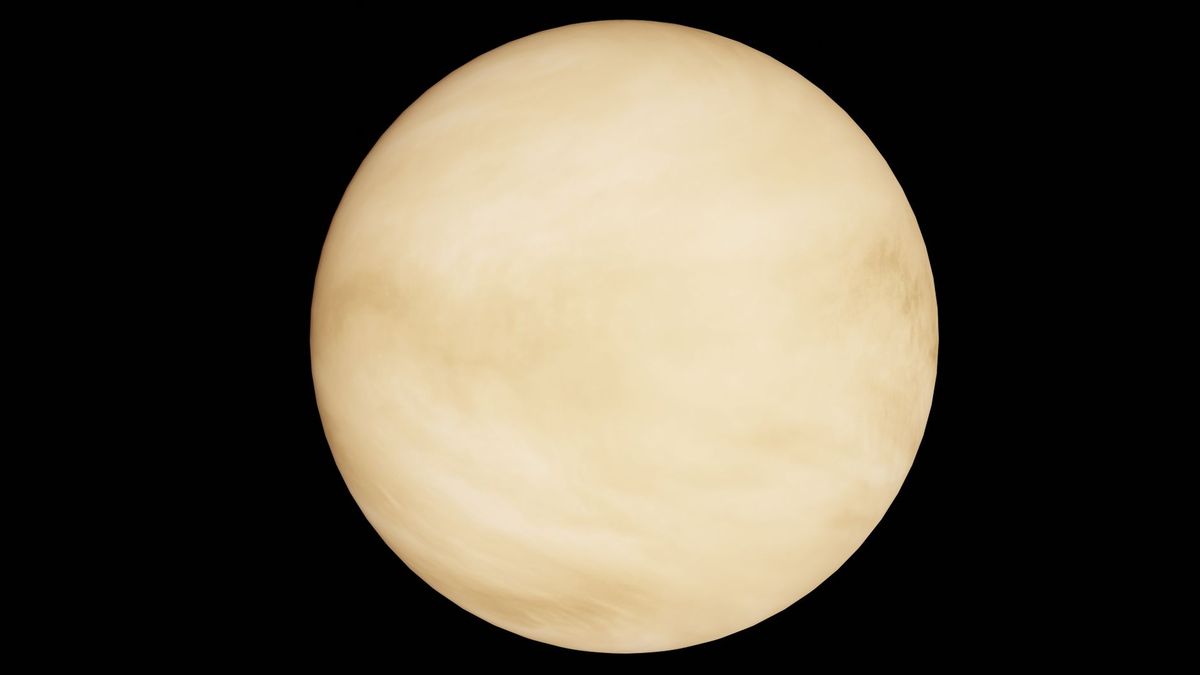
New research from scientists at the University of California, Riverside, suggests that Venus, our neighbouring planet, may once have had a moon that eventually crashed into it. This surprising theory could explain why Venus, despite its similarities to Earth, currently has no moon.
For a long time, scientists have been puzzled by Venus’s lack of a moon. Often referred to as ‘Earth’s twin’ due to their similar size, mass, and structure, Venus stands out among the inner planets for this absence. Previous theories included the possibility that a moon was destroyed in a massive collision with another space object, or that Venus simply never formed one in the first place.
A Moon Swallowed by its Planet
The new study, published in The Astrophysical Journal, challenges these earlier ideas. According to Stephen Kane, lead author and astrophysicist at UC Riverside, Venus’s own characteristics are the key. He explained, “It turns out the gravity of the planet itself combined with the rate at which it spins naturally caused the moon to collapse on top of it.”
This contrasts sharply with Earth and its moon. Earth completes a rotation relatively quickly, every 24 hours, and the energy from this spin is transferred to our moon, causing it to slowly move away at about four centimetres per year. Venus, however, has an extremely slow rotation, taking 243 Earth days to complete a single spin – meaning a day on Venus is longer than its year.
To test their theory, Dr. Kane developed computer models simulating how planetary bodies interact through gravity. After verifying the model using Earth and its moon, he applied various hypothetical moon sizes and Venus’s slow rotation rate. Across most simulations, the outcome was consistent: the moon spiralled inwards towards the planet and eventually crashed. The more massive the moon, the faster this collision would occur.
Researchers suggest that if Venus did have a moon, this catastrophic event could have taken place within the first billion years of the planet’s history, approximately 4.5 billion years ago, as reported by BBC Newsround.
Challenges and Future Insights
While the study provides a compelling explanation, it does not definitively prove that Venus ever had a moon. The findings simply demonstrate that if a moon did exist, Venus’s gravitational and rotational properties would have prevented it from remaining in orbit indefinitely.
Finding physical evidence of such a collision would be challenging because roughly 80% of Venus’s surface is of a similar age, indicating a major resurfacing event about a billion years ago that erased much of the planet’s earlier geological history. However, evidence might lie beneath the surface, similar to how seismic studies on Earth have revealed structures linked to our own moon’s formation.
The implications of this research extend beyond Venus. A moon crashing into Venus would have transferred enormous energy and angular momentum, potentially altering its rotation, geology, and climate. This could affect scientific understanding of whether Venus, or similar planets around other stars, could ever have hosted life. Scientists often consider the presence of a large moon as a factor for habitability, as Earth’s moon influences tides and geological activity.
Two future NASA missions, DAVINCI+ and VERITAS, are planned to study Venus’s atmosphere and geological features, which may offer further clues to its mysterious past.
Frequently Asked Questions About Venus
-
Why is Venus called ‘Earth’s twin’?
Venus is often referred to as ‘Earth’s twin’ because the two planets have very similar sizes.
-
How long is a day on Venus?
A day on Venus is longer than its year. It takes Venus 243 Earth days to spin once on its axis, but only 225 Earth days to complete an orbit of the Sun.
-
Why is Venus the hottest planet?
Venus is the hottest planet in our solar system, with an average temperature of 460°C. This is due to its thick atmosphere, which acts like a blanket, trapping the Sun’s heat inside.